 georglind.dk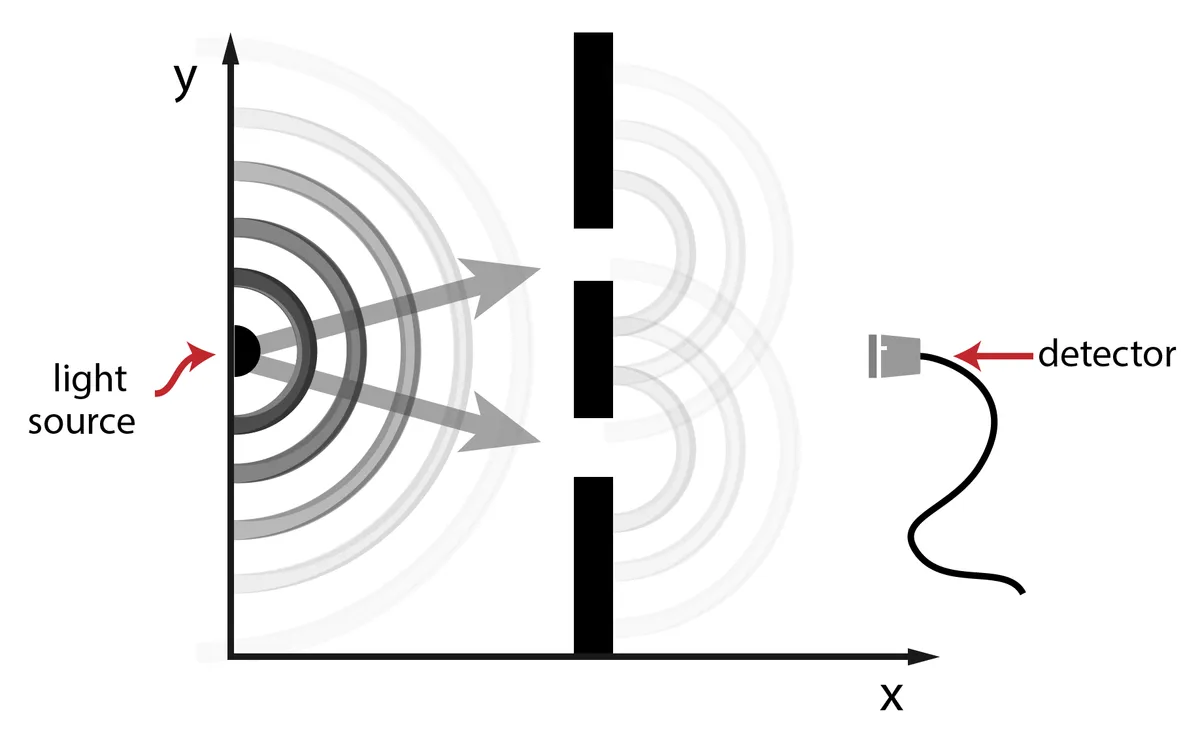
In this post I will give a pedagogical explanation of how quantum mechanical interference influences the electronic conductance of a single molecule.
This is a intuitive explanation of an instersting (and perhaps counter-intuitive) phenomena that I investigated in my PhD thesis.
The experimental setup
The setup — which have been realized in many labs around the world — involves a nano-meter-sized gold bridge, which is very carefully broken in order to create a nano-meter-sized gap. Then molecules are poured onto this golden gap and one prays that one of them will be caught in between the two electrodes, forming a very delicate molecular bridge. The transport properties of the molecule is then characterized by applying a voltage drop across this molecular junction and measuring the current response.
While electrons are normally thought of as particles, they will — due to quantum mechanics — also behave as waves. And what we seek to explain in this post, is how the wave nature of the electrons affects the transport properties of the molecular junction.
The two slit experiment
The most well-known wave property is interference, and our aim is to understand how interference can affect the electronic properties of molecular bridges. The main example of interference is the popularized two-slit-experiment:
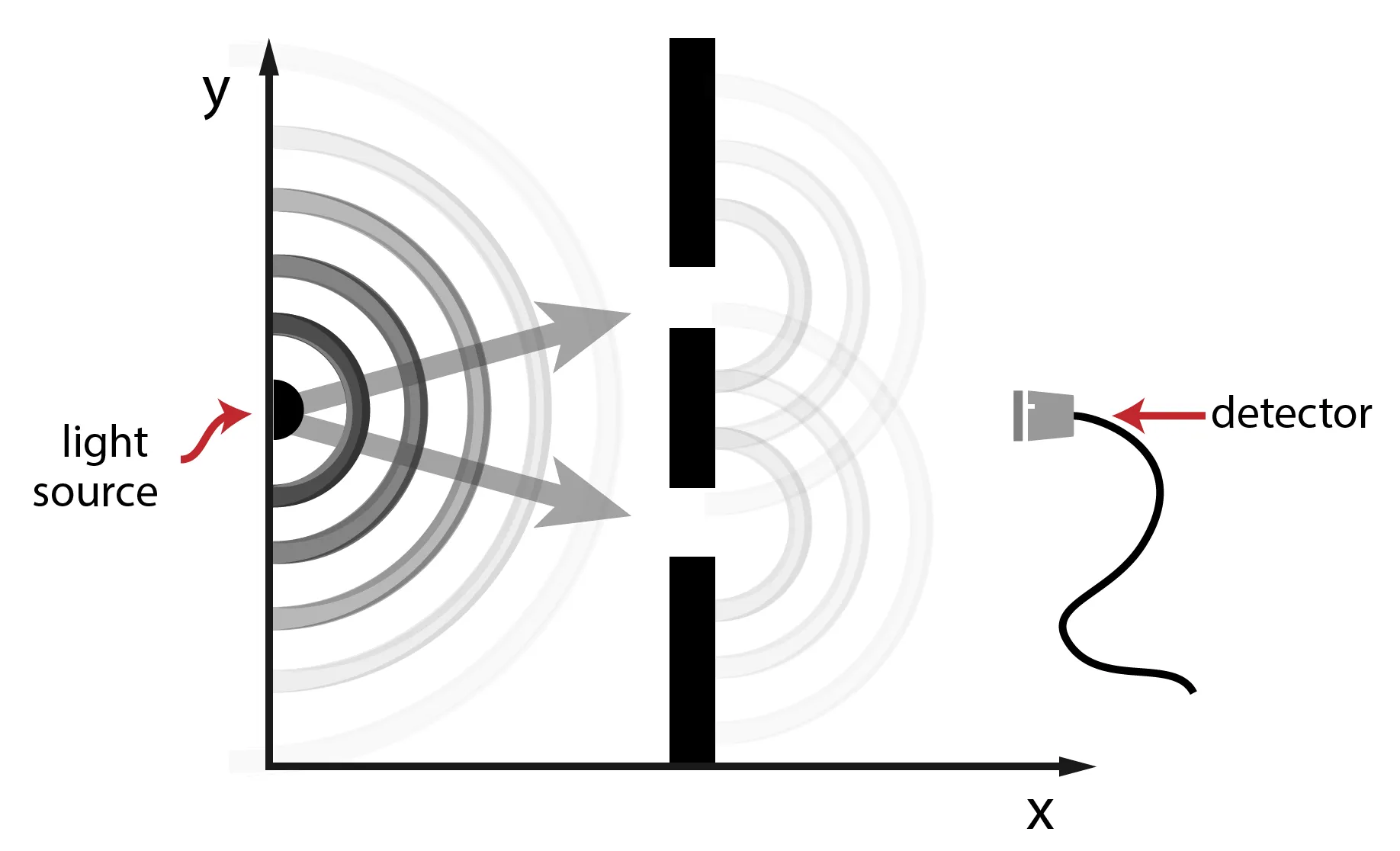
In the double slit experiment a wave originating on the left, passes through two slits and the wave intensity at some point in space is then detected by a detector. Here we will investigate what happens as we simultaneously change the position of the detector and the wave source on the vertical axis.
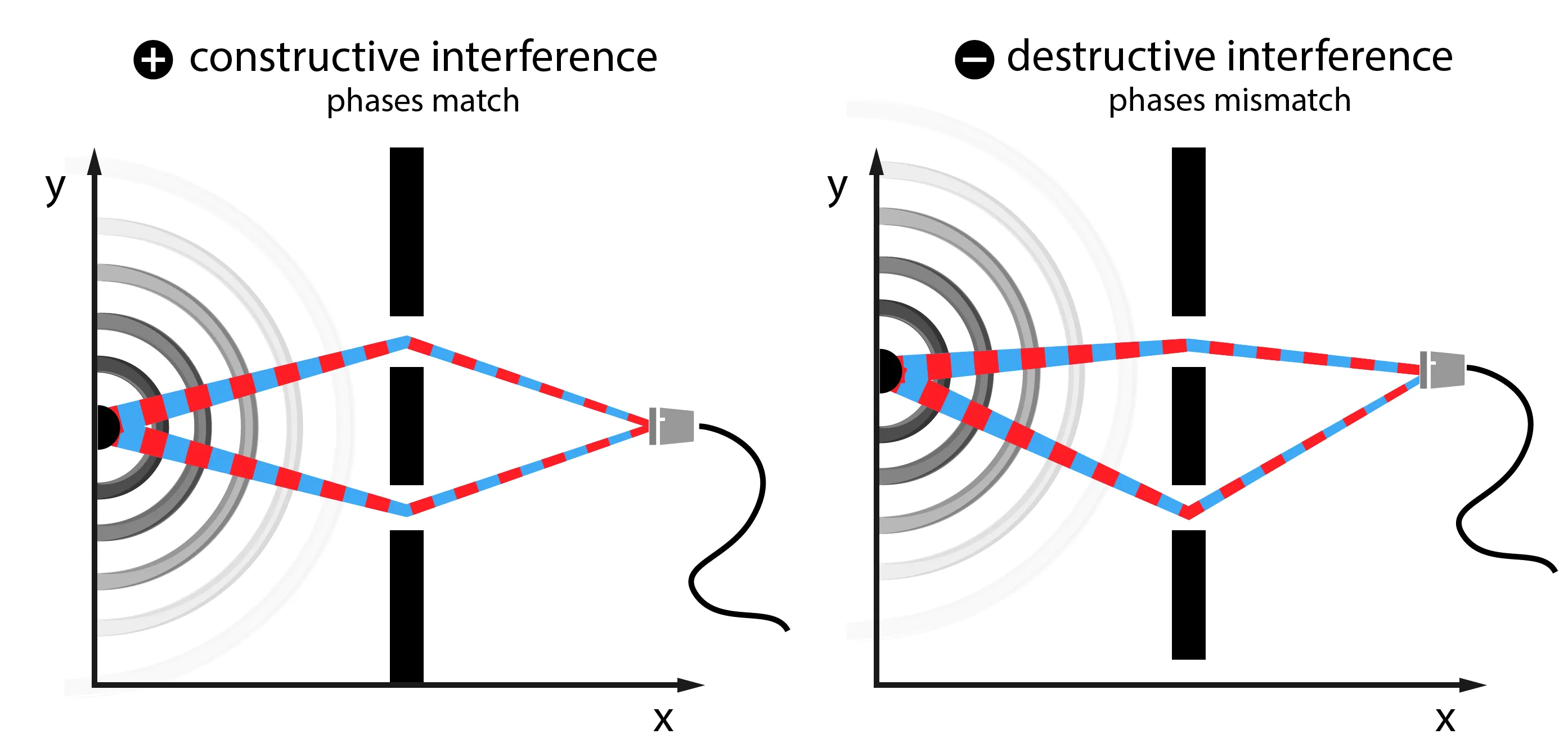
- In the middle between the two slits, the two paths are of equal length. The wave passing along those two paths share the same phase meaning that the waves add, and this phenomena is known as constructive interference.
- If we move both the source and the detector we encounter a different scenario. When the difference in path lengths exactly matches half a wavelength, the wave passing along the two paths is out of phase, and the waves substract — an effect known as destructive interference.
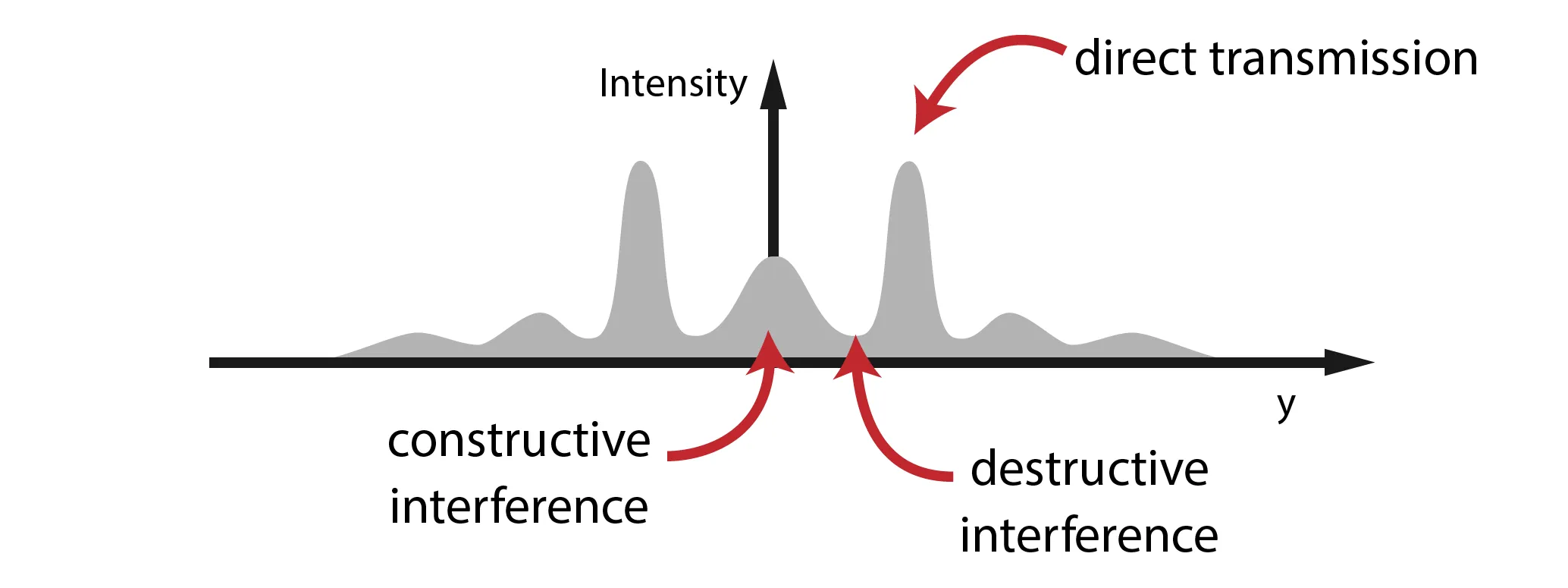
In fact, the wave intensity measured by the detector can be plotted as a function of the vertical displacement, y. The resulting transmission shows a characteristic interference pattern with valleys and hills corresponding to destructive and constructive interference effects. You may also note that when the source and the detector aligns with one of the slits, we may have perfect direct transmission:
Molecules
We are interested in transport through molecules. As we shall see, the molecular bridge can be thought of more or less like the two-slit-experiment that we just discussed. However, in molecular electronics we cannot control the actual vertical displacement of the electronic wave passing through the molecular bridge. Instead we have — through the bias voltage and perhaps a small electro-static gate — another very precise handle which we can control: The energy. In the following we will only look at situations where the energy of each electron passing through the molecule is conserved. That means that we cannot gain or loose energy by interacting with the electrodes, the molecule, the substrate or anything else in the setup.
Now, an electron enters the molecule with a certain energy, and it leaves with the exact same energy. This makes the energy equivalent to the vertical displacement, we discussed in the double slit experiment. This also means that it does not help us very much to look at only the molecular structure in real-space. In fact it is highly non-trivial to understand the wave-coherent transport through a molecule by just looking at the physical positions of the atoms in the molecule.
For simplicity we will constrict ourselves to a certain class of molecules: conjugated organic molecules. Conjugated organic molecules have a backbone of carbon atoms, and these atoms are strongly bound together by sigma bonds. In conjugated molecules those sigma-bonds all lie in the same plane, and perpendicular to this plane a single orbital sticks out from each carbon atomic site.
This orbital carries a single electron. The electrons are allowed to hop and delocalize over the entire system of orbitals. We call this system of orbitals and electrons for the pi-system. It is those pi-systems that we will consider in the following.
We may diagonalize the Hamiltonian governing the electronic pi-system, and find the eigenenergies and the eigenstates. The eigenstates can for simplicity be thought of as molecular orbitals, where each orbital can accommodate up to two electrons (depending on their spin).
Let us make these concepts more tangible by considering the pi-system of 1,3-butadiene. In the following figure we show how this molecule is put together, and we show the schematic and the molecular orbitals as a function of energy. Note that the molecular orbitals have different colors that actually correspond the sign of the wavefunction - that is the phase.
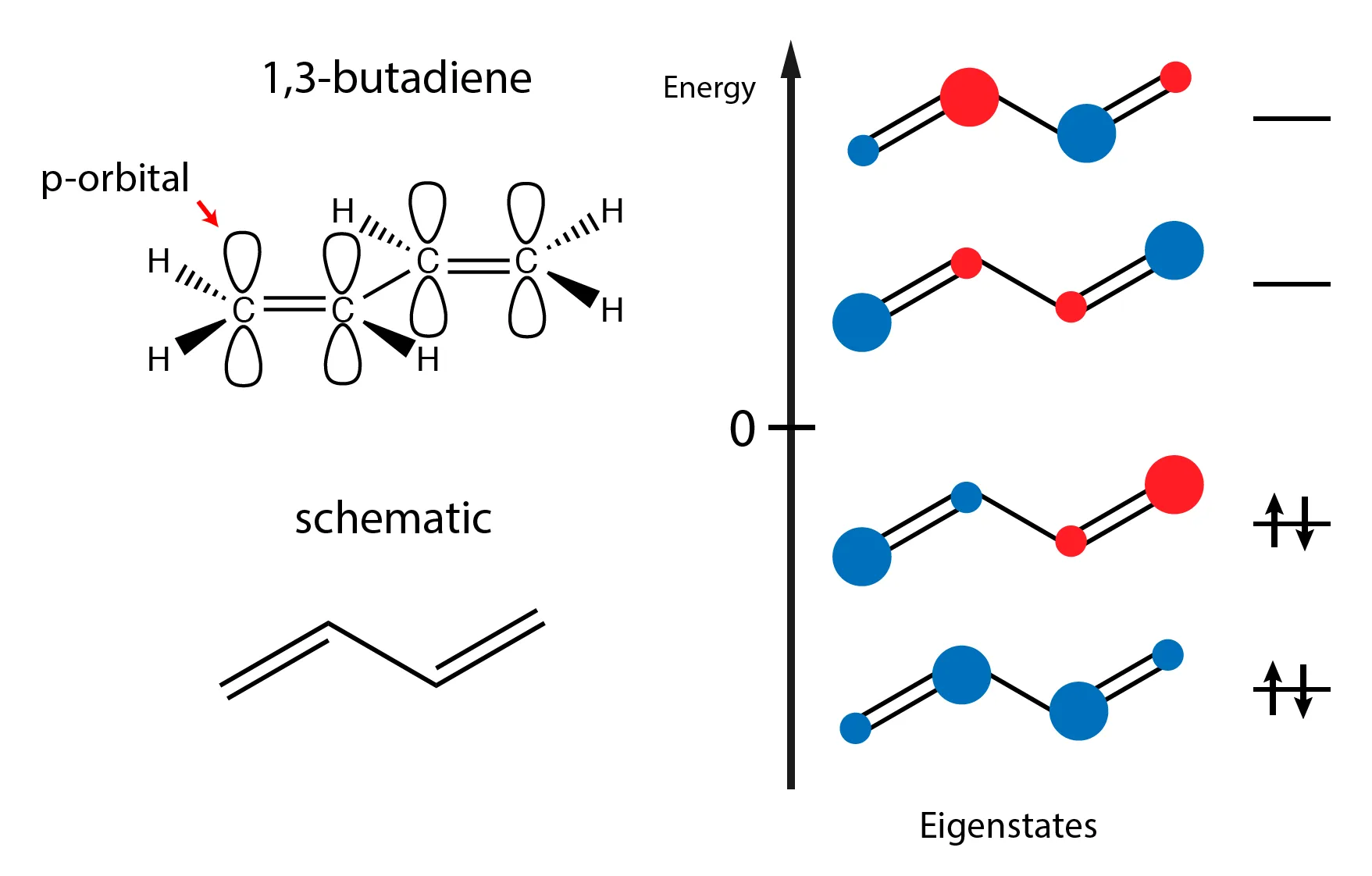
You may also note that we have filled up the molecular orbitals with the four available electrons (here drawn as up and down arrows). This fact will become important as we enter the next section.
Transport through molecules
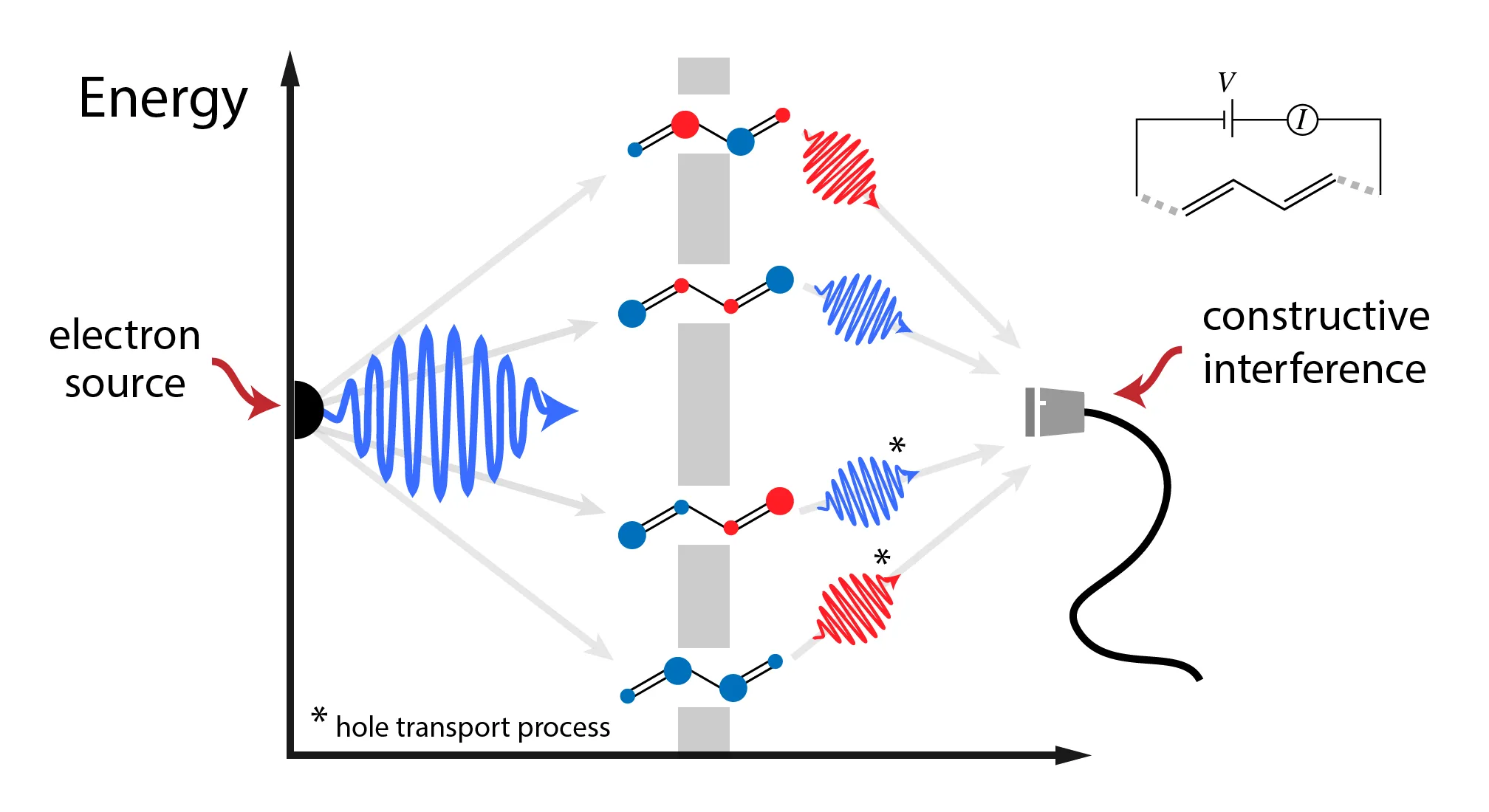
We are now able to to look at our molecule in energy space, and we are now ready to perform a simple transport experiment. An electron source sends in electrons with a certain energy. The electrons are then transmitted through the molecule and obtain a phase given by the molecular orbital, which it passes through. Like in the double slit experiment, the electrons are allowed to pass through slits which does not match the energy, as long as they end up with the same energy after the process.
Lets splash some electron-waves on 1,3-butadiene and see what we get:
Colors
As you can see, the electronic wave-packets have been colored according to the phase they have at each stage of the transport process. This is obviously true for the transport processes which happen through the unoccupied orbitals (with positive energy). Here the electron is added to the molecule, propagates, and is finally removed.
Hole transport : However, the electrons cannot move through the orbitals already occupied by electrons (negative energy). Instead one must take out an electron, allow the hole to propagate and then add the incoming electron. Because electrons are fermions this reversal of the process gives an additional sign relative to transport through unoccupied orbitals.
In our coloring this means the orbitals marked with a * has an additional color flip from blue to red or vice versa.
Looking at the phases, we expect to find constructive interference at zero energy (all colors add up). Here comes the transmission as a function of energy:
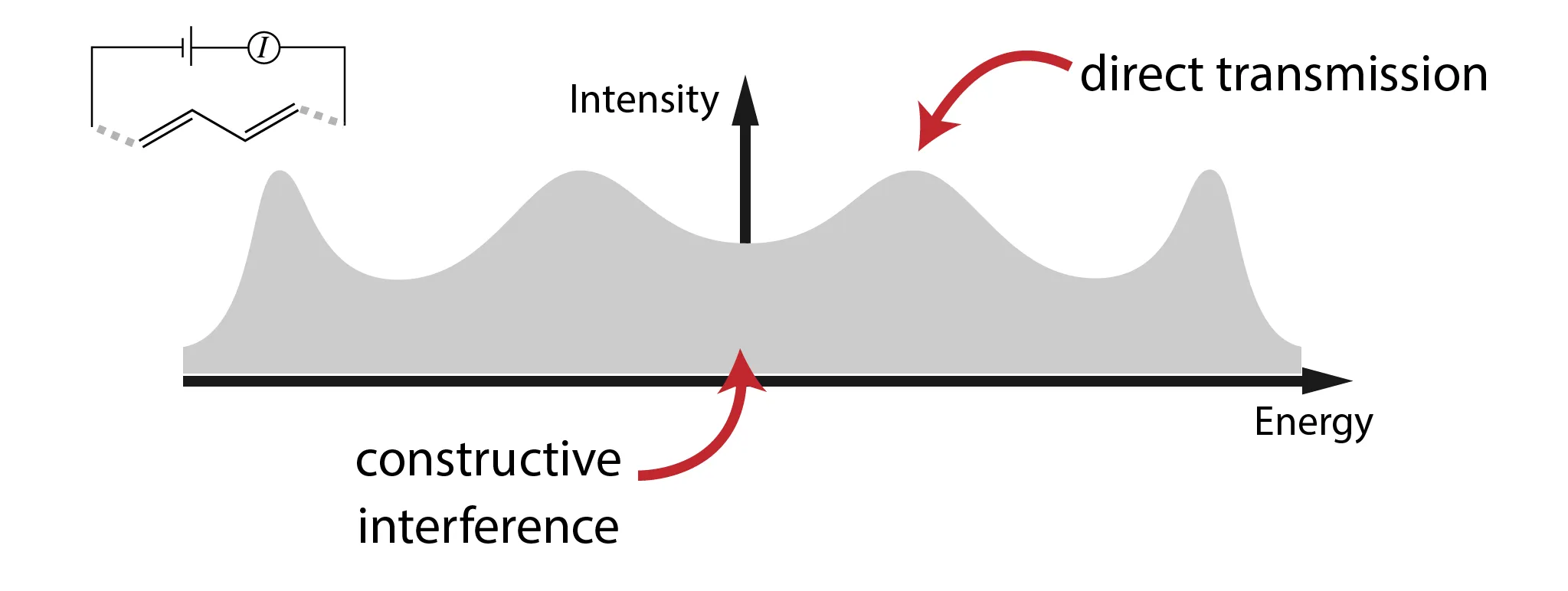
Not many surprises there. This would be almost indistinguishable to the case where we interpreted the electrons as being classical particles. In principle we did not really need any interference or quantum mechanics to explain constructive interference. But, don’t worry. All this was not in vain.
Destructive interference
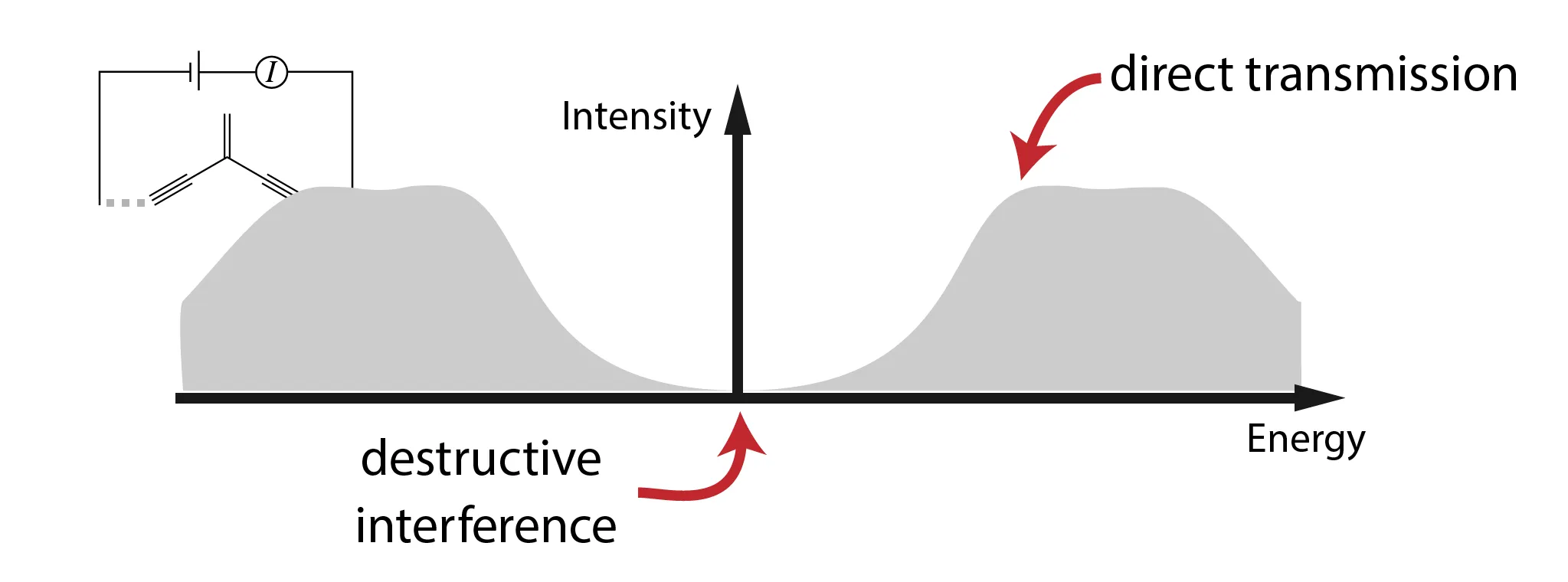
The hallmark of wave interference is really the presence of destructive interference. So let us look at a slightly different molecular junction.
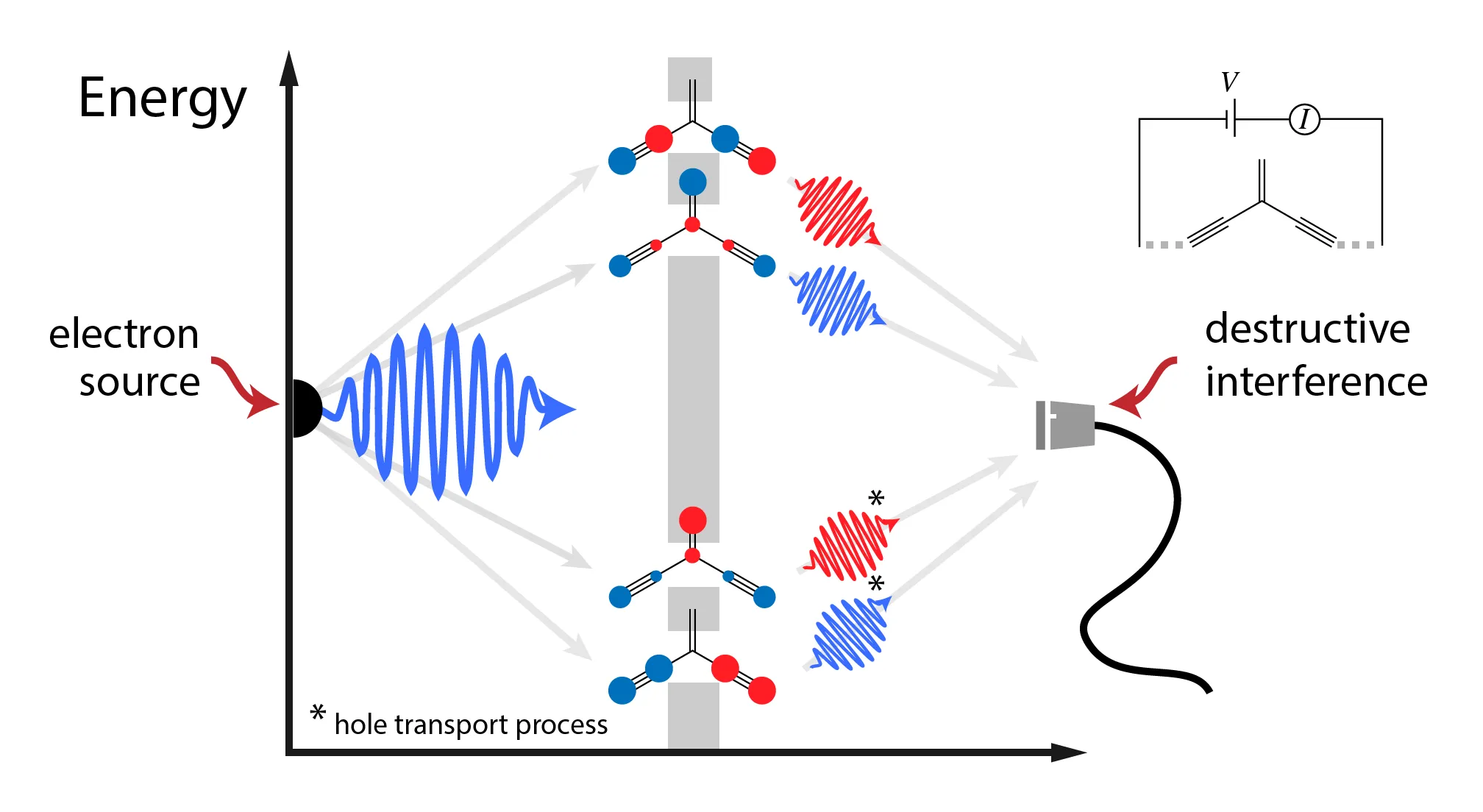
Again the colors correspond to the wave-function phase, and the hole transport processes have gotten an extra sign because of “fermionic exchange” (we will come back to this shortly). In this case we see that the contributions are out of phase, and so we expect the transmission to vanish at zero energy.
Lo and behold:
One question and one answer
In conclusion, quantum interference in molecular systems can be understood in analogy to the well-known double slit experiment. But instead of “real-space” interference, molecular transport interference must be understoof as happening between different paths in “energy-space”. The dominant contribution then comes from interference between the two “nearest” molecular orbitals (nearest in terms of energy).
An overall sign difference between the phases of the two molecular orbital paths will them lead to destructive interference.
You may wonder how this picture changes, when you add Coulomb repulsion between the electrons. Interestingly enough, the picture only changes slightly. The reason is that the same explanation holds, if we instead of molecular eigen-states generalize to Feynman-Dyson many-body orbitals. You can read more about those generalized molecular orbitals in this publication.